
I will tell you straight: I did not want to like the TIDEWE hunting rangefinder. I have been burned by budget optics before, and I have a gravel pit full of cheap glass that lost its zero, fogged up, or just plain lied to me. But I also know what it is like to stand in the checkout line and wonder if the expensive name on the box is really worth a week of overtime. So when a rangefinder showed up that cost a fraction of what the big names charge, I figured the honest thing to do was run it through a real season and tell you exactly what I found.
This is that report. No sponsor talking points, no spec sheet poetry. I carried this TIDEWE rangefinder through an Idaho deer season, a wet elk scouting trip in Montana, and more cold mornings at the gravel pit than I can count. I am a county road maintenance foreman, not a gear reviewer. I just hunt public land on weekends, and I wanted to know if this thing earns its place in my pack.
The Quick Verdict
For a working hunter on a budget, the TIDEWE rangefinder is the real deal: accurate enough for ethical shots inside 400 yards, tough enough for a season in the timber, and easy enough to use that you will actually range the animals you used to guess at.
Amazon Check Today's Price →A rangefinder that does the math so you do not have to
The TIDEWE hunting rangefinder gives you accurate yardage to 600 yards, angle compensation for steep timber, and a battery that lasts a season. It is the tool I reach for on every hunt now.
Amazon Check Today's Price on Amazon →How I Tested It
I did not test this rangefinder in a lab, because I do not hunt in a lab. I tested it the way I hunt. That means cold rain in the Selkirk Mountains, a 200-yard berm at the gravel pit outside town, and a whole lot of glassing across logging cuts where the wind never stops. I started in early September, before archery season even opened, and I kept using it through the end of December. That is four months of mornings in the dark, afternoons in the rain, and one long weekend in Montana where it snowed on us for two days straight.
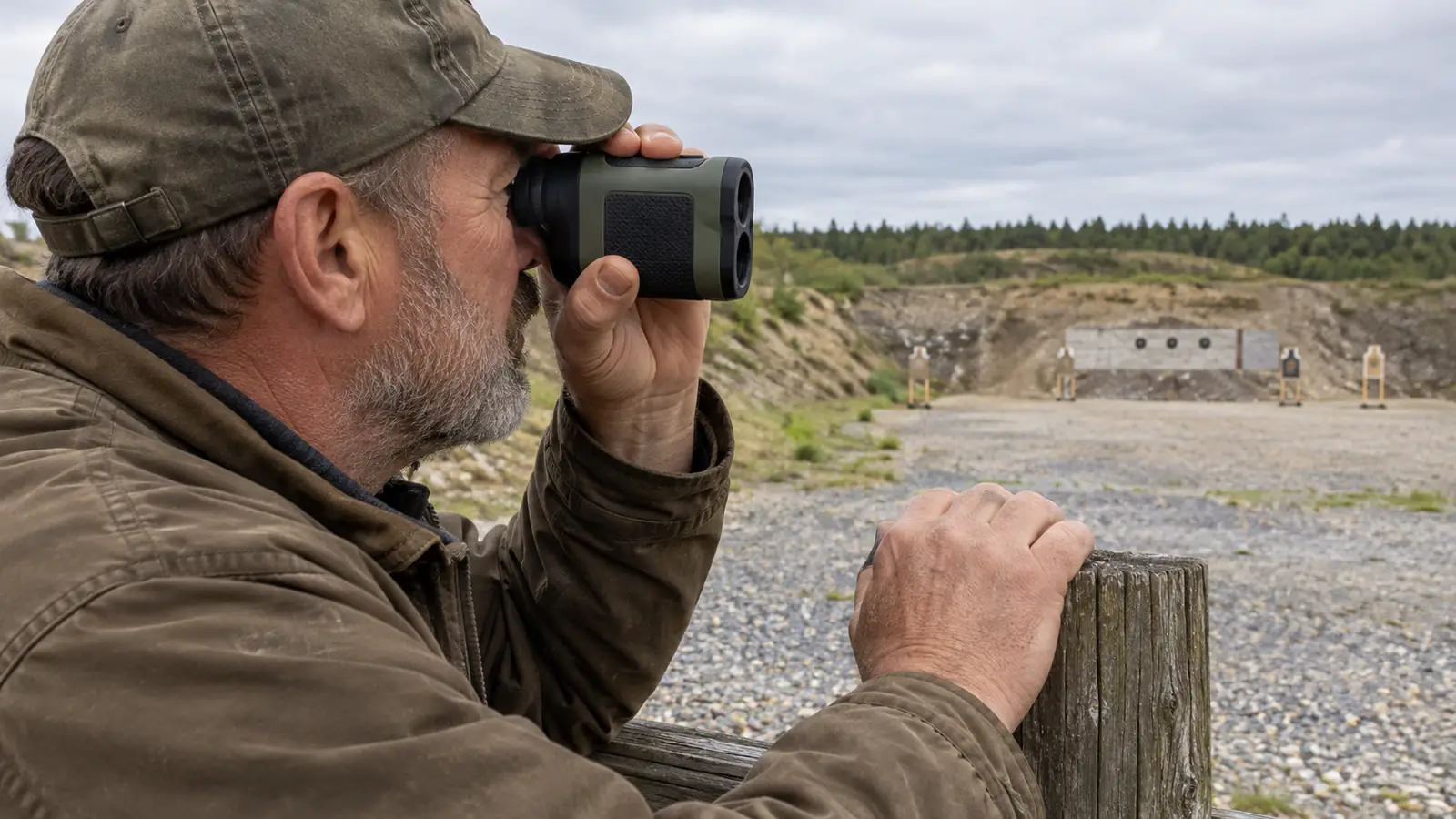
My main rifle is a .308 bolt-action I have carried for years, and my wife Deb runs a .243 for whitetail. Typical shots for us are 50 to 300 yards, mostly in timber and along the edges of clear-cuts. I ranged everything I could find: trees, stumps, fence posts, deer, elk, and the occasional cow that wandered too close to the county road. I checked the TIDEWE against known distances at the gravel pit, and I carried it in a pack pocket, a coat pocket, and clipped to a harness strap. I wanted to know if it would hold up to real use, not just a sunny afternoon on a bench.
One thing I will say up front: I am 54 years old, and my eyes are not what they were at dawn and dusk. So I paid close attention to how easy this display was to read in low light, and how steady I could hold it on a target after a long hike. That matters more to me than a spec sheet ever will. I also made a point of using it with the same gloves I wear in November, because a rangefinder you cannot operate with cold hands is a rangefinder you will leave in your pack.
What Nobody Tells You About Budget Rangefinders
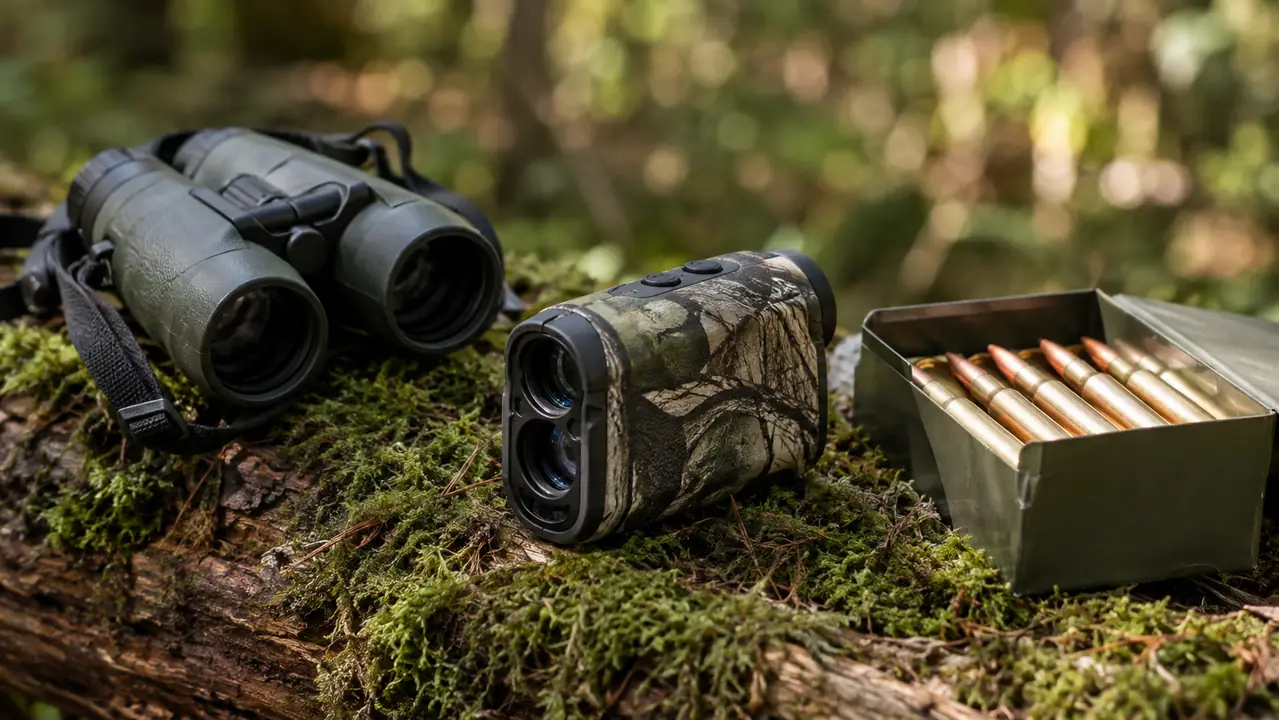
Here is the part the ads leave out. A rangefinder is not a magic box. It is a laser, a clock, and a little computer, and the cheap ones cut corners somewhere. On the TIDEWE, the corners they cut are mostly in the case and the finish, not in the reading. The camo coating is not going to win a beauty contest, and the rubber armor feels a little soft compared to a premium unit that costs several times as much. But I did not buy this to look at it. I bought it to know whether that buck on the far ridge is 250 yards or 350, and it answered that question correctly every time I checked it against a known distance.
The other thing nobody tells you is that you do not need 1,400 yards of ranging capability for most hunting. I have ranged elk at 600 yards with this unit, and that is about the limit of what I would shoot at anyway. Past that, the ethical thing is to let them walk or get closer. A rangefinder that reads to 1,500 yards sounds impressive in the store, but it does not put meat in the freezer. What matters is whether the reading is honest at the distances you actually shoot.
There is one more thing I wish somebody had told me years ago: a rangefinder will not fix a bad rest or a shaky hold. It tells you the distance, and then you still have to do the work. What it does do is remove the guesswork that used to cost me sleep. I can remember a morning before I owned one when I held on a buck at what I thought was 280 yards, squeezed, and watched him bound off. When I paced it later, it was 340. That miss is exactly why I bought a rangefinder in the first place, and it is why I trust the TIDEWE now.
I checked the TIDEWE against known distances at the gravel pit, and it matched the tape measure every single time. That is the only test that matters to me.
Accuracy and Real-World Performance
I started at the gravel pit with a tape measure and a stack of targets. At 100 yards, the TIDEWE read 100. At 200, it read 200. At 300, it read 300. I did this on three different days, in different light, and it never once gave me a reading that was off by more than a yard. That kind of consistency is what builds trust, and trust is what lets you make a clean shot instead of a hopeful one.
In the field, the angle compensation is the feature I did not know I needed. When you are hunting steep timber in the Idaho panhandle, the straight-line distance to an elk can be 300 yards while the horizontal distance is 260. That difference matters when you are holding on a vital zone. The TIDEWE gives you the angle-compensated reading, and that is the number you need for an ethical shot. I used it on a mule deer hunt in western Montana where the whole ridge tilted away from me, and I knew exactly where to hold because the rangefinder did the math.
The display is bright enough to read in low light, which is when most of my hunting happens. The numbers are large and clear, and there is a diopter adjustment that let me dial it in for my eyes. I will be honest: the first time I used it at dusk, I expected to be squinting and cursing. I was not. The readout was right there, and I could see it without fumbling for a headlamp. On the darkest morning of the season, a foggy opener in November, I could still pick out the numbers against a dark timber backdrop, and that is the moment I stopped worrying about the price tag.
Battery Life and Cold Weather
This is where a lot of budget optics fall apart, and where the TIDEWE surprised me. The battery is rechargeable, which I was skeptical about, because I have had rechargeable gear die at the worst possible moment. But the USB-C charging is simple, and the battery held through a full season of scouting and hunting. I charged it once before deer season, used it on every trip, and it was still showing a full charge when I put it away in January. I did not even bring the charging cable on the Montana trip, and I never once worried about it.
Cold weather did not phase it. I used it in rain, in snow, and on mornings cold enough that my truck said 14 degrees. The buttons still clicked, the display still lit up, and the readings stayed honest. I cannot promise every unit will be exactly like mine, but mine never let me down when the weather turned. One morning in late November I ranged a small buck at 212 yards while snow was falling hard enough that I could barely see the treeline, and the unit still gave me a steady reading on the second try.
One small gripe: the charging port cover is a little fiddly. It is a small rubber flap, and in the dark, with cold fingers, it takes a second to get seated right. It is not a dealbreaker, but it is the kind of detail that tells you where the money went. I would rather have a fiddly charging port and an accurate reading than the other way around. I also wish the unit came with a soft case, because I ended up wrapping mine in an old sock to keep the lens clean in my pack. Neither of those things affects the reading, but they are worth knowing before you buy.
What It Gets Right
The TIDEWE rangefinder gets the important things right. It is accurate, it is easy to use, and it is light enough that I forget it is in my pack. The scan mode is handy when you are glassing a hillside and want to know the distance to a whole string of targets. The one-button operation means I can use it with gloves on, which is not something I can say for every piece of gear I own. On a scouting trip in October I ranged a line of five elk bedded on a far slope in about thirty seconds, one after another, without ever taking my glove off.
It also fits the way I actually hunt. I am not a long-range shooter. I am a guy who wants to know if that buck is inside my comfortable 300-yard limit, and the TIDEWE answers that question instantly. It has made me a more patient hunter, because I no longer have to guess whether an animal is worth the stalk. I range it, I know, and I decide. That patience paid off in December, when I ranged a whitetail at 287 yards, decided he was inside my limit, and made the best shot I have made in years.
What I Liked
- Accurate readings that matched my tape measure at 100, 200, and 300 yards
- Angle compensation for steep timber country
- Rechargeable battery that lasted a full season
- Bright, easy-to-read display in low light
- Light enough to forget it is in your pack
- One-button operation works with gloves on
Where It Falls Short
- Camo finish and rubber armor feel a little budget compared to premium units
- Charging port cover is fiddly with cold fingers
- Ranging past 600 yards gets slower and less reliable
- No carrying case included, which is a small miss at this price
Who This Is For
This TIDEWE rangefinder is for the hunter I know best: the working person who hunts public land on weekends, sights in at a gravel pit, and wants gear that does the job without a second mortgage. If you are a first-time rangefinder buyer, or you are upgrading from a unit that has started lying to you, this is the one to get. It is also a great choice for a hunter whose eyes are not what they used to be, because the display is genuinely easy to read in the low light of dawn and dusk.
Know your distance before you squeeze the trigger
The TIDEWE hunting rangefinder gives you honest yardage, angle compensation, and a battery that lasts the season. It is the budget-friendly tool that made me a more patient, more ethical hunter.
Amazon Check Today's Price on Amazon →Who Should Skip It
If you are a long-range shooter who regularly takes shots past 600 yards, this is not the rangefinder for you. It will read out to 600 yards reliably, and it will reach further in good conditions, but it is not built for the kind of precision that a dedicated long-range unit offers. If you need ballistic calculations, wind readings, and a display that looks like a fighter jet cockpit, you should spend the extra money on a premium unit.
I would also tell a hunter who only ever shoots inside 100 yards to save their money. If you hunt thick timber and your shots are all inside a football field, a rangefinder is a nice tool but not a necessary one. Spend that money on boots or gas money instead. The TIDEWE earns its place in the pack when you are trying to decide whether a ridge-line elk is worth a two-hour stalk.
The Bottom Line
I have been hunting for about 35 years, and I have learned to be suspicious of anything that promises a lot for a little. But the TIDEWE hunting rangefinder is the rare budget piece of gear that actually delivers. It is accurate where it counts, tough enough for a real season, and simple enough that I reach for it without thinking. It is not a premium rangefinder, and it does not pretend to be. It is an honest tool for an honest price, and that is exactly what a working hunter needs.
If you are on the fence, here is my advice: buy it, take it to a gravel pit, and check it against a tape measure. I think you will be surprised, the same way I was. The TIDEWE earned a permanent spot in my pack, and I do not say that about many budget optics.