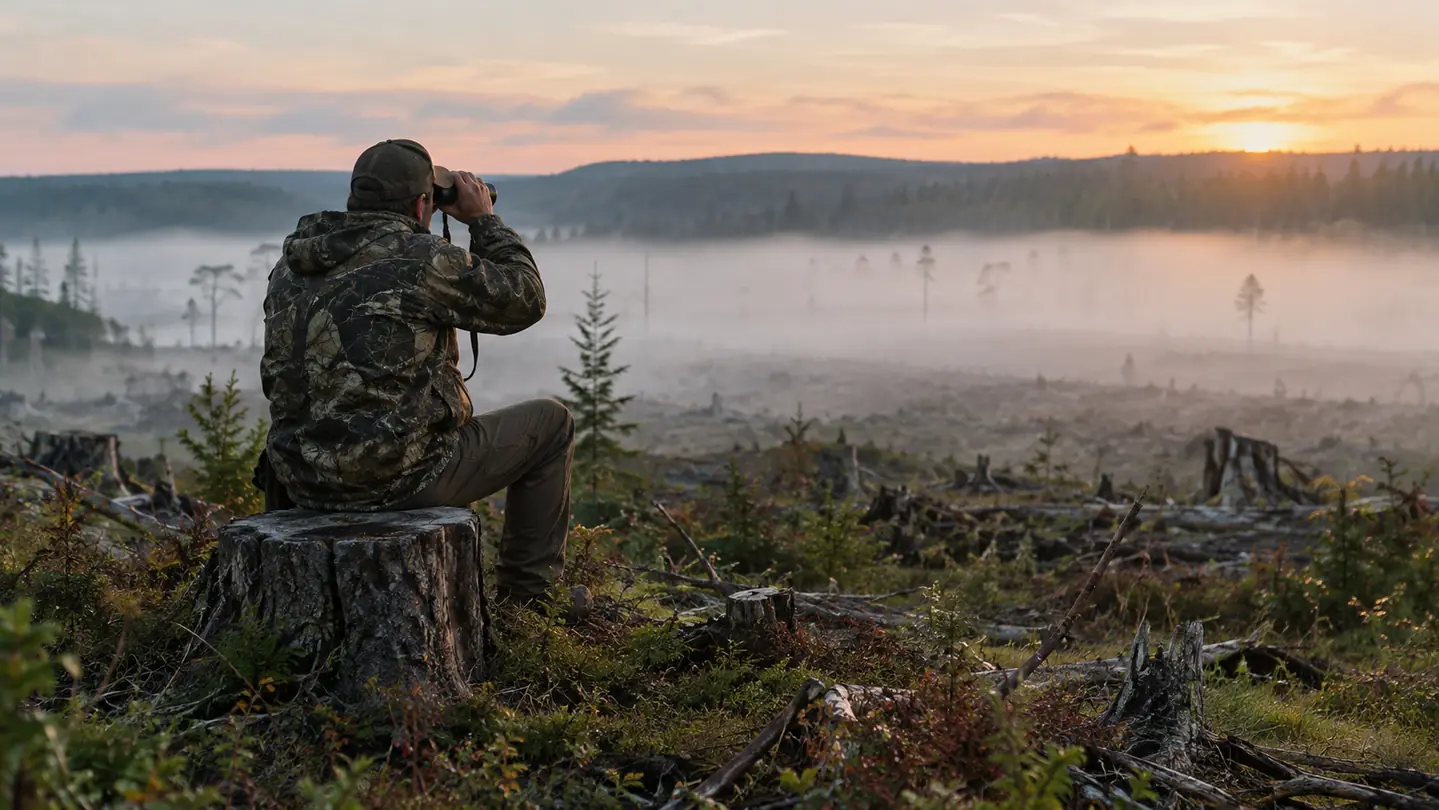
The first light in a clearcut is the best hour of the day to find elk, and the worst hour to try to see them. The cut is still half in shadow, the frost is burning off the grass, and the elk that fed out onto the slash overnight are starting to think about moving back into the timber. You get maybe twenty minutes where they are visible and calm. Miss that window and you are just staring at stumps. I have been hunting public land in the Idaho panhandle for about 35 years, and I have learned that the difference between a filled tag and a long walk out empty is usually not the rifle. It is how well you read the cut at first light. It is also what you are looking through. I run a pair of Vortex Triumph HD 10x42 binoculars on almost every scouting trip now, and they changed how I work a clearcut more than any rifle upgrade I have made.
This is not a guide for the guy with a spotting scope on a tripod and a rangefinder that talks to his phone. This is for the working hunter who gets one weekend, maybe two, and needs to cover a clearcut fast and honestly. Here is the system I use, step by step, from the moment I park the truck to the moment the elk either show themselves or don't.
Start with glass that lets you see into the shadows
The Vortex Triumph HD 10x42 is the pair I keep on the seat of my truck all season. Clear enough to pick an elk out of dark timber edge at first light, tough enough to bounce around in a work truck, and priced like it was made for a county road foreman. Check today's price on Amazon and see if it fits your setup.
Amazon Check Today's Price on Amazon →Step 1: Get into position before the sky turns
You cannot glass a clearcut from the truck. Elk that feed in a cut at night are looking for two things: grass and safety. They will feed out into the open only when they feel secure, and they feel secure when they can see a long way in every direction. That means the edge of the cut is the worst place to stand. You are right where they expect a predator to be.
I like to be set up on the opposite side of the cut from where I expect the elk to be, or on a point that lets me look across the opening at a slight angle. The goal is to have the sun behind me and the cut in front of me. In the panhandle, that usually means I am on a logging road above the cut, or on a bench on the far side. I want to be in position and have my Vortex binoculars out of the case at least fifteen minutes before shooting light. If I am still walking when the sky starts to turn, I have already lost the best part of the hour.
One more thing on position: get your back against something. A tree, a stump, a bank. It steadies your arms, it breaks up your outline, and it keeps you from slowly drifting sideways while you glass. I have missed more elk because I was wobbling than because my binoculars were not good enough.
Step 2: Start wide, then work the edges
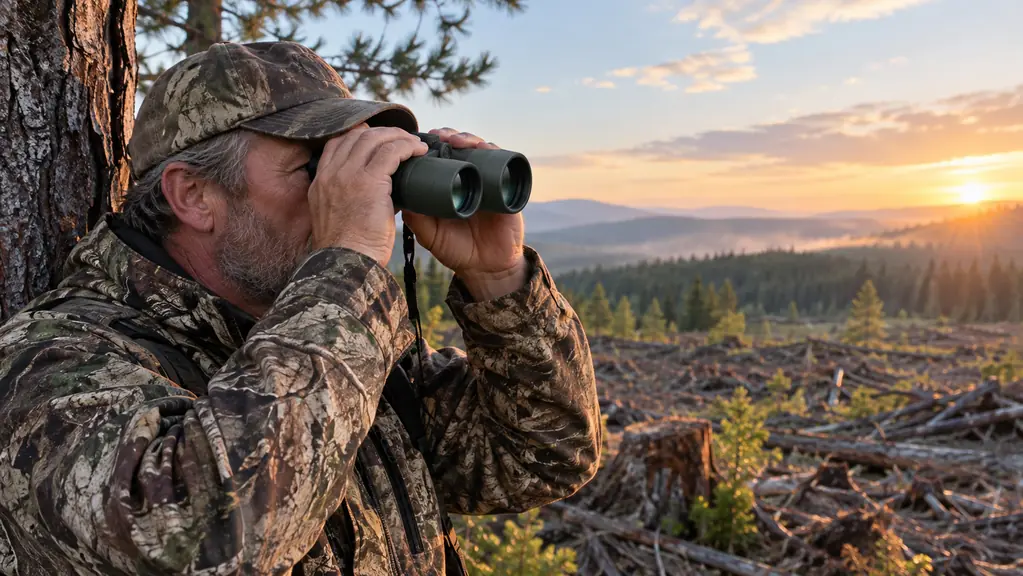
The mistake most hunters make is to pick up the binoculars and start looking for an elk. That is backwards. You are not looking for an elk. You are looking for a shape that does not belong. An elk at 300 yards in a clearcut is a dark patch that is slightly the wrong color, or a horizontal line where the grass should be vertical, or an ear that flicks when everything else is still.
I start with a slow sweep of the whole cut, left to right, at the lowest power I can get away with. With the Vortex Triumph HD 10x42, that is 10 power, which is plenty wide for a clearcut. I am not trying to identify anything on that first pass. I am looking for anything that is not a stump, not a rock, and not a shadow. Then I go back and work the edges: the timber line, the brushy draws, the little pockets of grass between the slash piles. That is where elk will be at first light, especially if there is any pressure on the unit.
The HD glass in the Triumph matters most right here. At first light, the elk are standing half in the timber and half in the open, and the difference between a cow and a shadow is a few percent of contrast. I have used cheap binoculars that turned that edge into a gray smear. The Vortex holds the line between the dark timber and the lighter grass, and that is the difference between seeing an ear move and walking past a whole herd.
Step 3: Pick a spot and stare at it
Once I have done a wide sweep, I pick the three or four spots where elk are most likely to be and I stare at each one for a full minute. Not a glance. A full minute. Elk are masters of standing perfectly still, and your eye will not pick them up until they move. If you keep sweeping, you will never give any one spot enough time for that movement to register.
This is where a steady hold matters more than magnification. I sit, I put my elbows on my knees, and I let the binoculars settle. The Vortex Triumph HD has enough eye relief that I can wear it against my brow without fighting for the full field of view, which helps me stay still. I count to sixty in my head. If nothing moves, I move to the next spot. If something moves, I do not yank the binoculars down. I keep them up, find the shape, and let it resolve.
The other trick is to watch the spots where the elk are most likely to appear, not the spots where they already are. A bull that is going to step out of the timber will usually pause just inside the treeline first. If I am staring at the open grass, I will miss the pause. I watch the edge, and the open grass takes care of itself.
Step 4: Read the body language before you commit
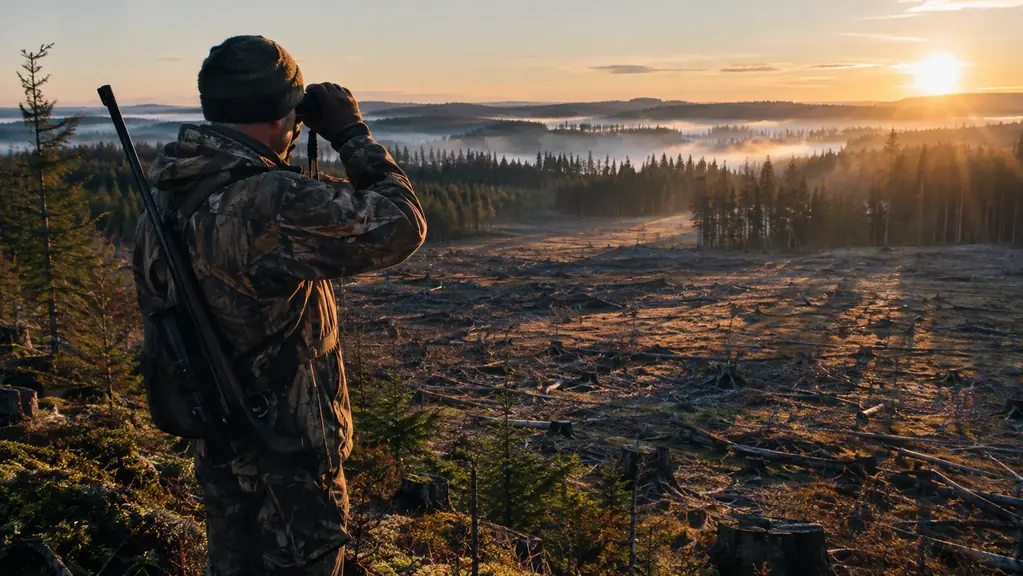
When you do find elk in a clearcut at first light, do not immediately start planning the shot. Read them first. A herd that is feeding calmly, with heads down and calves moving around, is a herd you can work. A herd that is staring at you, with heads up and ears forward, is a herd that is about to leave. The difference is ten seconds of observation, and it decides whether you get a shot or you get a look at the back of a herd going over the ridge.
I also watch the direction they are facing. Elk almost always feed into the wind, and they almost always exit the cut the same way they came in. If I can see the trail they used to get into the cut, I know where they will go when they leave. That tells me whether I should try to close the distance now, or whether I should back out and set up on the exit trail instead. Most hunters try to close the distance. The smarter play is often to let the elk come to you.
This is also the moment to be honest with yourself about the shot. If the elk are 400 yards across the cut and you are a 250-yard shooter, the answer is not to take the shot. The answer is to watch where they go and plan the next move. The Vortex Triumph HD will show you the elk clearly at 400 yards. It will not make you a better shot. Know your limit before you need it.
Step 5: Work the cut in layers, then move
A clearcut is not one flat opening. It is a series of layers: the open grass, the brushy regrowth, the slash piles, the timber edge, and the little benches and draws that break up the slope. Elk will use every one of those layers depending on pressure, feed, and time of day. If I glass the whole cut and see nothing, I do not assume the elk are not there. I assume I have not looked in the right layer yet.
I work the cut in layers, starting with the open grass, then the brush line, then the timber edge, then the draws. I give each layer the same slow sweep and the same full-minute stares. Then, if I still have not found elk, I make a decision: I either move to a new position that gives me a different angle on the same cut, or I move to the next cut. Elk are creatures of habit, but they are also creatures of pressure. If the first cut is empty, the second one often is not.
The key is to keep moving with purpose. I have spent too many mornings glassing the same cut from the same stump, hoping the elk would materialize. They do not. They are either there or they are not. My rule now is simple: if I have given a cut a full, honest look and seen nothing, I am gone within thirty minutes. The Vortex Triumph HD packs light enough that moving to the next cut does not feel like a chore, and that is a real advantage when you are covering public land on a weekend.
What Else Helps
Good binoculars are the backbone of glassing a clearcut, but they are not the whole system. A lightweight tripod or a shooting stick will steady a 10x pair enough to pick out details at the far edge of a cut, and it saves your arms on a long morning. A rangefinder helps you know whether the elk you are looking at is a 200-yard shot or a 350-yard shot, which matters more than most hunters want to admit. And a good pack with the binoculars accessible on your chest strap means you actually use them instead of leaving them in the truck. None of that costs a fortune. The Vortex Triumph HD 10x42 is the piece I would not skip, because every other tool is useless if you cannot see the elk in the first place.
The difference between a filled tag and a long walk out empty is usually not the rifle. It is how well you read the cut at first light.
Give yourself the best twenty minutes of the day
First light in a clearcut is a short window, and the right binoculars make the difference between seeing the elk and walking past them. The Vortex Triumph HD 10x42 is the pair I trust on public land, and it won't break the budget. Check today's price on Amazon and get your glass ready before the season starts.
Amazon Check Today's Price on Amazon →